Calculating flue gas loss: formula, factors and a worked example
Flue gas temperature, combustion air temperature, oxygen and two fuel factors: this is the flue gas loss formula as it stands in Annex 2 of the 1. BImSchV, and how to work it through on three examples.
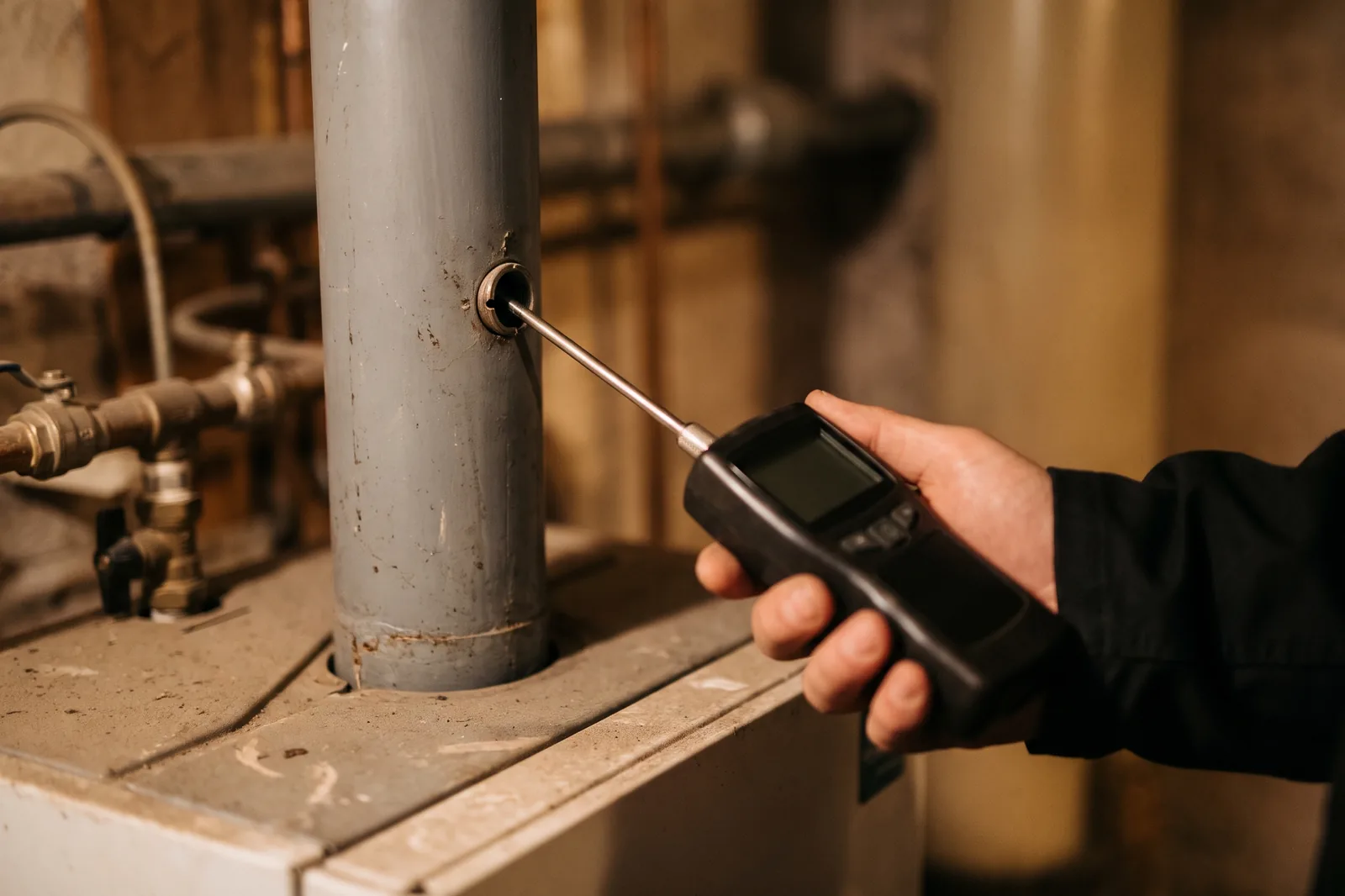
A chimney sweep who wants to calculate flue gas loss needs four readings and two factors. The analyser does the sum in seconds today, but knowing the formula lets you spot an implausible value at once and explain to an owner why the old boiler failed. Here is the formula exactly as it stands in the German 1. BImSchV, with the factors for heating oil, natural gas and LPG and three worked examples.
The source is Annex 2 No. 3.4 of the 1. BImSchV. The only binding text is the ordinance itself.
From the analyser straight into the phone
Kehrwerk records the flue gas loss and checks it against the limit. Free for one person, no sign-up.


What flue gas loss is
§ 2 No. 1 of the 1. BImSchV defines flue gas loss as the difference between the heat content of the flue gas and the heat content of the combustion air, relative to the calorific value of the fuel. Put simply: the share of the fuel's energy that goes up the chimney hot instead of heating the house. A flue gas loss of 8 percent means 8 percent of the energy put in is lost with the flue gas.
The formula from Annex 2 No. 3.4.1
The ordinance writes flue gas loss as qA and calculates it like this:
qA = (tA minus tL) times (A divided by (21 minus O2) plus B)
- qA: flue gas loss in percent
- tA: flue gas temperature in degrees Celsius
- tL: combustion air temperature in degrees Celsius
- O2: oxygen content by volume in the dry flue gas, in percent
- A and B: fuel-dependent factors
The factors are in the same number of Annex 2:
- Heating oil EL, natural vegetable oils, vegetable oil methyl ester: A = 0.68, B = 0.007
- Gases from the public gas supply: A = 0.66, B = 0.009
- Coke oven gas: A = 0.60, B = 0.011
- LPG and LPG and air mixtures: A = 0.63, B = 0.008
How it is measured
Annex 2 No. 3.4.1 also governs the measurement. Oxygen and flue gas temperature are determined quasi-continuously as a 30 second average, at the same time and at the same point. Combustion air temperature is measured near the intake of the heat generator, or at a suitable point in the supply duct for room-sealed appliances.
The general rules of No. 1 and 3.1 apply as well: measure in the core of the flue gas stream, in undisturbed steady operation at rated output. For oil with atomising burners and for gas, no earlier than two minutes after the burner starts. For hot water heating, the boiler water should be at least 60 degrees at the start, except for condensing boilers and low temperature boilers with sliding control.
Example 1: gas boiler on natural gas
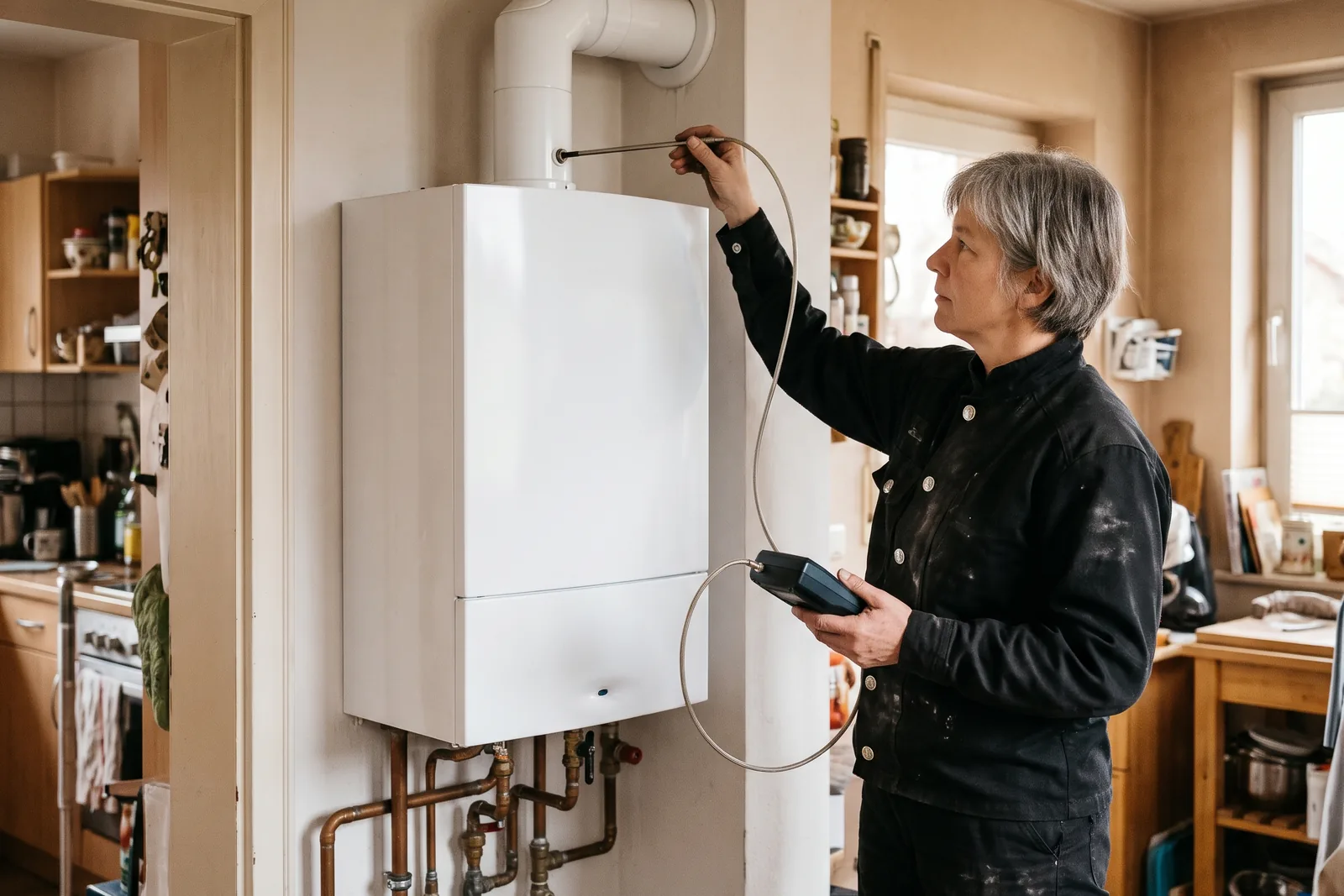
A 20 kW wall-mounted gas boiler on natural gas from the public supply. Measured: flue gas 110 degrees, combustion air 20 degrees, oxygen 4.0 percent.
- Temperature difference: 110 minus 20 = 90
- A divided by (21 minus 4.0): 0.66 divided by 17 = 0.0388
- plus B: 0.0388 plus 0.009 = 0.0478
- times 90: flue gas loss about 4.3 percent
At 20 kW, § 10 (1) sets a limit of 11 percent. Met, with plenty of room.
Example 2: oil boiler in good condition
A 30 kW oil boiler on heating oil EL. Measured: flue gas 180 degrees, combustion air 18 degrees, oxygen 4.5 percent.
- Temperature difference: 180 minus 18 = 162
- 0.68 divided by (21 minus 4.5) = 0.68 divided by 16.5 = 0.0412
- plus 0.007 = 0.0482
- times 162: flue gas loss about 7.8 percent
At 30 kW the limit is 10 percent. Met.
The analyser calculates, Kehrwerk checks
Type the flue gas loss, see the limit. The app knows the rated output of every appliance. Download it free.
Example 3: old oil boiler just over
An older 20 kW oil boiler on heating oil EL. Measured: flue gas 230 degrees, combustion air 15 degrees, oxygen 7.0 percent.
- Temperature difference: 230 minus 15 = 215
- 0.68 divided by (21 minus 7.0) = 0.68 divided by 14 = 0.0486
- plus 0.007 = 0.0556
- times 215: flue gas loss about 11.9 percent
Limit at 20 kW: 11 percent. Exceeded. The example shows the levers. Less excess air lowers the oxygen and with it the fraction. A lower flue gas temperature, for instance after cleaning the heating surfaces, lowers the temperature difference. At 5 percent oxygen and 200 degrees flue gas, the same boiler would be under 10 percent.
Rounding and measurement uncertainty
Under Annex 2 No. 3.4.2 together with No. 2.3, the result is determined with one more decimal place than the limit and rounded under DIN 1333. The limit is met if the measured value minus the measurement uncertainty does not exceed it. That is why the certificate under Annex 2 No. 4 records the flue gas loss together with its measurement uncertainty.
What Kehrwerk does with the value
Your analyser calculates the flue gas loss. Kehrwerk records it together with the other readings: heat carrier temperature, combustion air temperature, flue gas temperature, oxygen, draught. As you type, the app checks the flue gas loss against the limit for the appliance's rated output and shows the result right under the field.
- Values with a decimal comma, as German analysers show them.
- Oxygen above 21 percent or a flue gas loss above 100 percent is flagged as a typing error.
- Every keystroke is saved at once, even with no signal.
- The PDF shows the reading, the limit and whether it was met or exceeded.
Because every input to the formula is in the protocol, the office can trace any flue gas loss later with the formula above.
Download it and try it on the next oil boiler
Free forever for one person. No account, no server, the measurement stays on your phone.
What is the formula for flue gas loss?
qA = (tA minus tL) times (A divided by (21 minus O2) plus B). That is how it stands in Annex 2 No. 3.4.1 of the 1. BImSchV.
Which factors apply to natural gas?
For gases from the public supply A = 0.66 and B = 0.009. For heating oil EL A = 0.68 and B = 0.007, for LPG A = 0.63 and B = 0.008.
Does Kehrwerk calculate the flue gas loss?
No, your analyser provides it. Kehrwerk records it with all inputs and checks it at once against the limit for the rated output.
Over what period are oxygen and flue gas temperature averaged?
Over 30 seconds, quasi-continuously, at the same time and the same point. That is what Annex 2 No. 3.4.1 requires.
What brings a high flue gas loss down?
The formula shows two levers: a lower flue gas temperature and a lower oxygen content, meaning less excess air. Both depend on the setting and condition of the appliance.
Try Kehrwerk on your next reading.
The chimney sweep app for flue gas readings on site. Free forever for one person, no signup.