Guide: set Germany, Austria or Switzerland for your business
One setting under Business decides which rules Kehrwerk measures by: 1. BImSchV, Art. 15a B-VG or LRV. What it changes on the appliance, in the measurement and in the protocol.
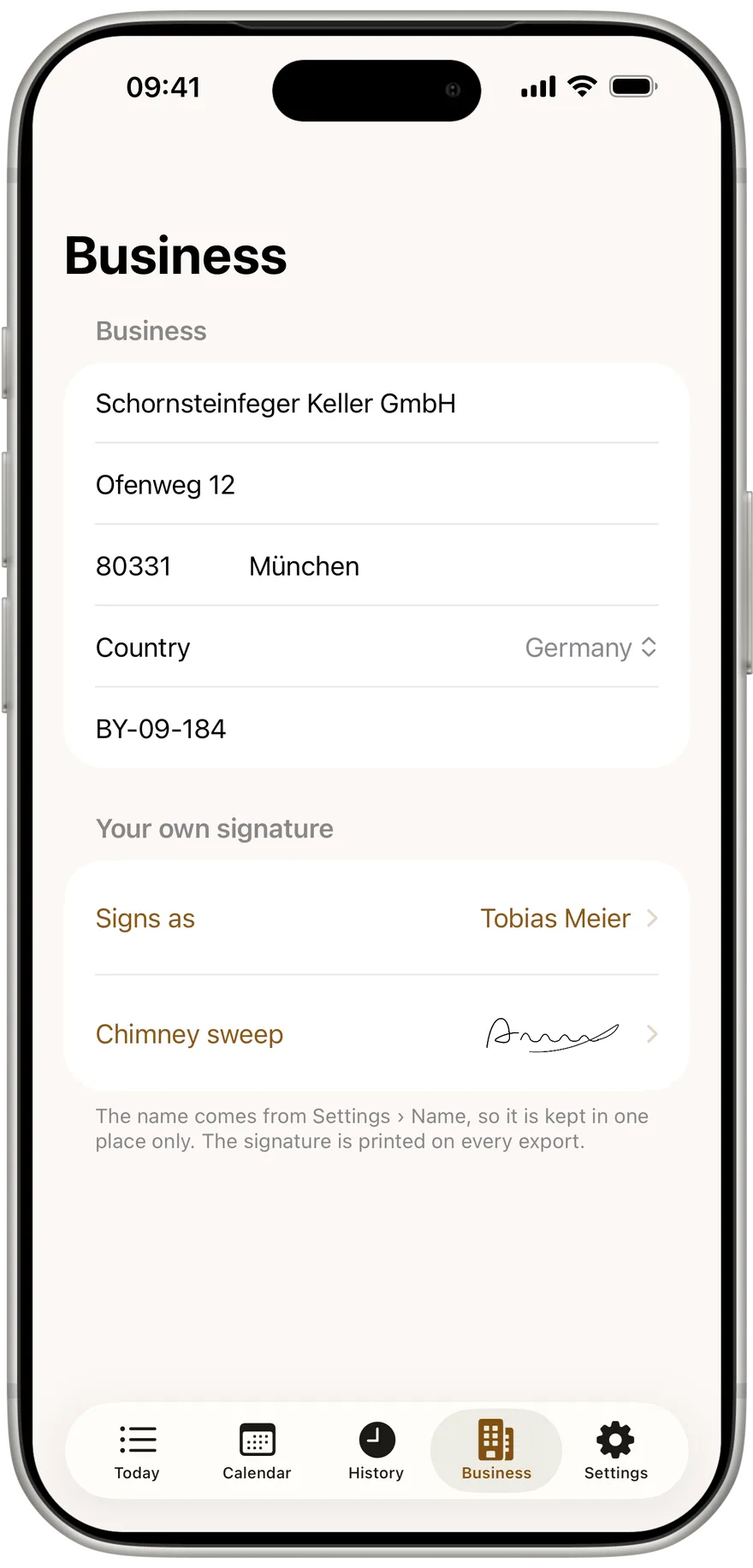
Chimney sweeps in Germany, Austria and Switzerland do the same work in the boiler room under different rules. Each country asks for different values and sets different limits. The Kehrwerk app knows all three rule sets. You choose which applies once, and from then on every measurement shows exactly the fields and limits your rules require.
Step 1: choose the country under Business
Open "Business". In the first section, with the business address, is the "Country" row with three options: Germany, Austria and Switzerland. Below it the app explains what the choice does: the country decides the limits and the measured values for new properties, Germany 1. BImSchV, Austria Art. 15a B-VG, Switzerland LRV. Completed measurements keep their country.
So the country here is not a letterhead line but the choice of rule set. Every new property, created by hand or imported by CSV, takes it.
The rule set for your country, in one app
Germany, Austria or Switzerland with one tap. Kehrwerk is free for one person for good and needs no account.


Step 2: change one property's country if needed
If you work near a border you sometimes have a property on the other side. Every property has its own "Country" row for that. Open the property details in the appointment; it sits with the address. The note below says it decides the limits and values for this property, and new properties take the business's country.
An open measurement follows its property. "Complete measurement" fixes the country into the measurement. If you later change the property or the business, the completed measurement stays with the rule set it was signed under.
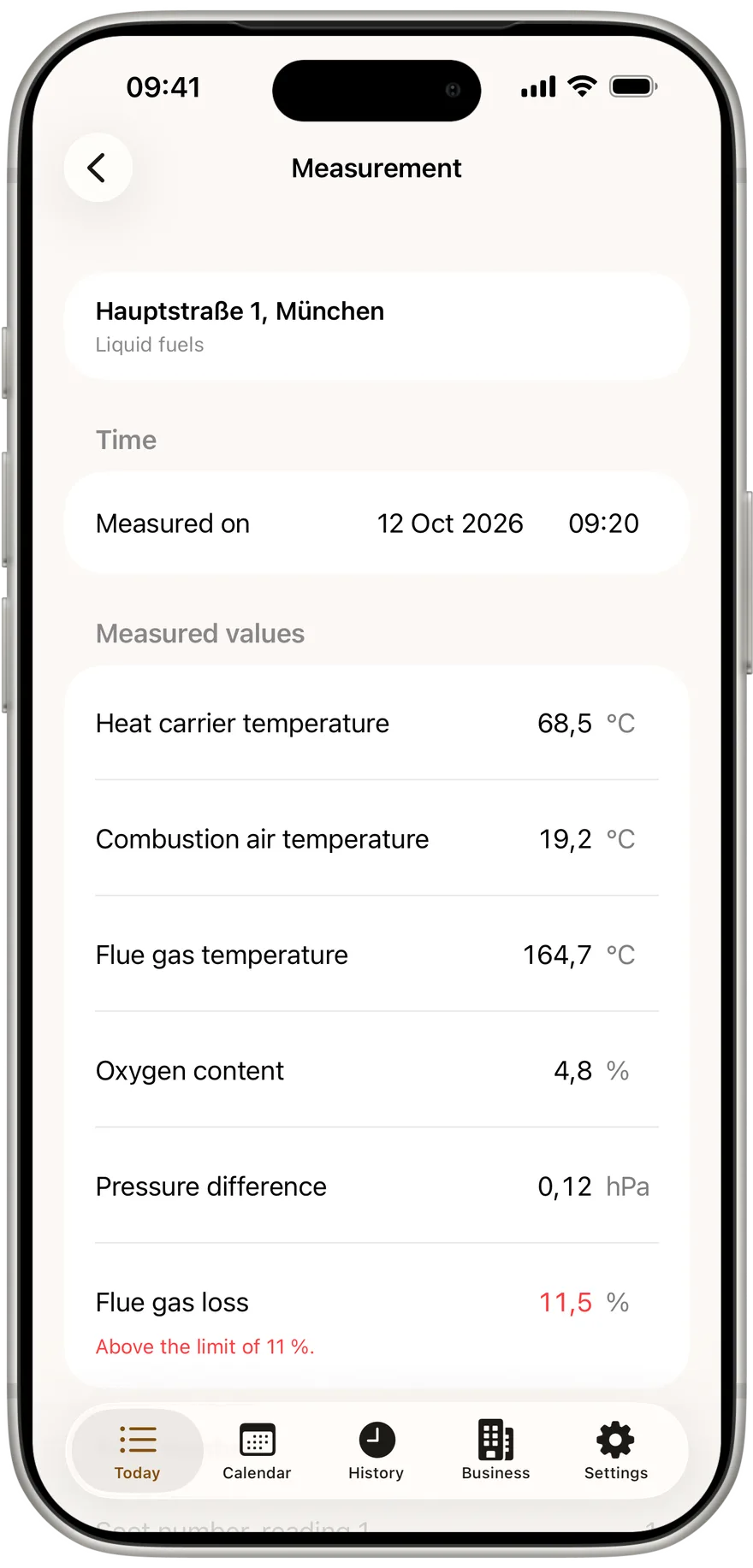
What changes: the measured values
The measurement shows only the fields your rules require for that type of appliance. For a gas or oil boiler that means:
- Germany: heat carrier temperature, combustion air temperature, flue gas temperature, oxygen content, pressure difference, flue gas loss.
- Austria: carbon monoxide content, oxygen content, combustion air temperature, flue gas temperature, heat carrier temperature, pressure difference, flue gas loss. Austria asks for CO on every fuel.
- Switzerland: combustion air temperature, flue gas temperature, oxygen content, carbon monoxide content, nitrogen oxides (NO₂), flue gas loss.
For wood and other solid fuels, Germany adds dust, carbon monoxide and fuel moisture, Austria asks the same seven values as for gas and oil, and Switzerland asks flue gas temperature, oxygen, dust and carbon monoxide. CHP units have their own fields, in Germany under KÜO Anlage 2 with CO undiluted and three annular gap readings.
What changes: the limits
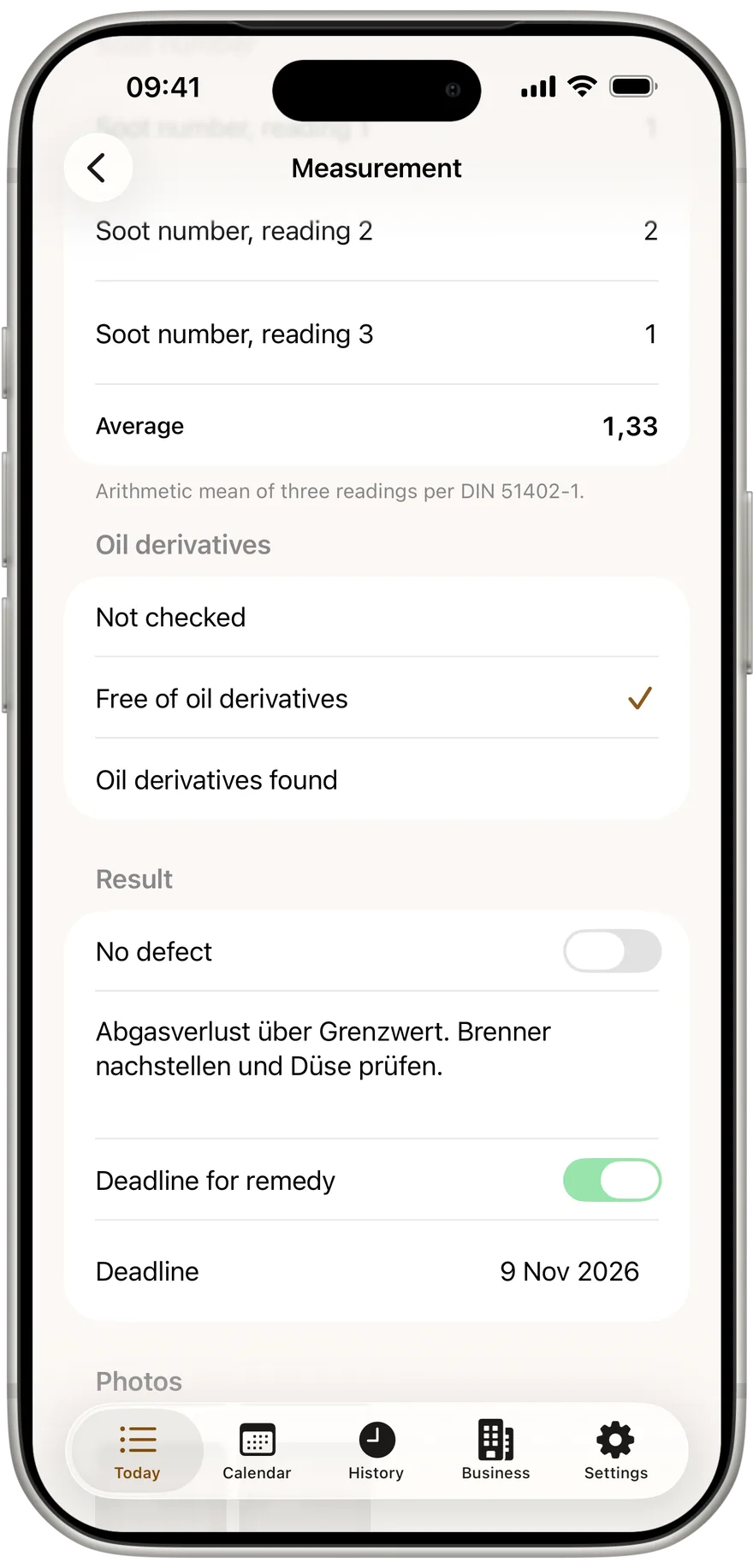
- Germany, 1. BImSchV: flue gas loss for gas and oil follows the rated output, over 4 to 25 kW 11 percent, over 25 to 50 kW 10 percent, over 50 kW 9 percent. A CHP unit is held to CO undiluted of 1000 ppm under KÜO § 1 (2).
- Austria, Art. 15a B-VG: below 50 kW gas and oil are held to 10 percent flue gas loss and 100 mg/m³ CO, oil also to soot number 1. For solid fuels the limit depends on feeding: manual 20 percent and 3500 mg/m³ CO, automatic 19 percent and 1500 mg/m³ CO.
- Switzerland, LRV Annex 3: flue gas loss comes from burner and stage, not from output, single stage 7 percent, first stage 6 percent, second stage 8 percent. Boilers commissioned from 1 January 2019 may not exceed 4 percent. CO and nitrogen oxides apply at 3 percent reference oxygen, for wood dust and CO at 13 percent.
Under every judged field the result appears as soon as a value is in. For concentrations the app names the reference oxygen too, such as "bei 3 % O₂". A Swiss CO limit without it would be half the rule.
The right limit on either side of the border
Kehrwerk checks by 1. BImSchV, Art. 15a B-VG and LRV, with no signal needed. Free for one person.
What changes: the appliance details
Where the rules need more than the output, the appliance asks for extra details under "Details". In Germany you never see this section, because the kW are enough. In Austria and Switzerland it appears only on the appliances it applies to:
- Burner: in Austria for solid fuels manual or automatic feed, in Switzerland for oil forced draught or atmospheric burner.
- Stage: in Switzerland for gas and oil, single, first or second stage.
- Commissioning date known: in Switzerland for gas and oil, with the date, because of the 4 percent rule.
- Fuel: for CHP units in Austria and Switzerland, such as natural gas or heating oil.
If one of these is missing, the top of the measurement says which: in Switzerland, for example, that burner and stage are missing and the limit cannot be checked without them. One tap on "Details" on the appliance, make the choice, and the check runs.
What changes: the protocol
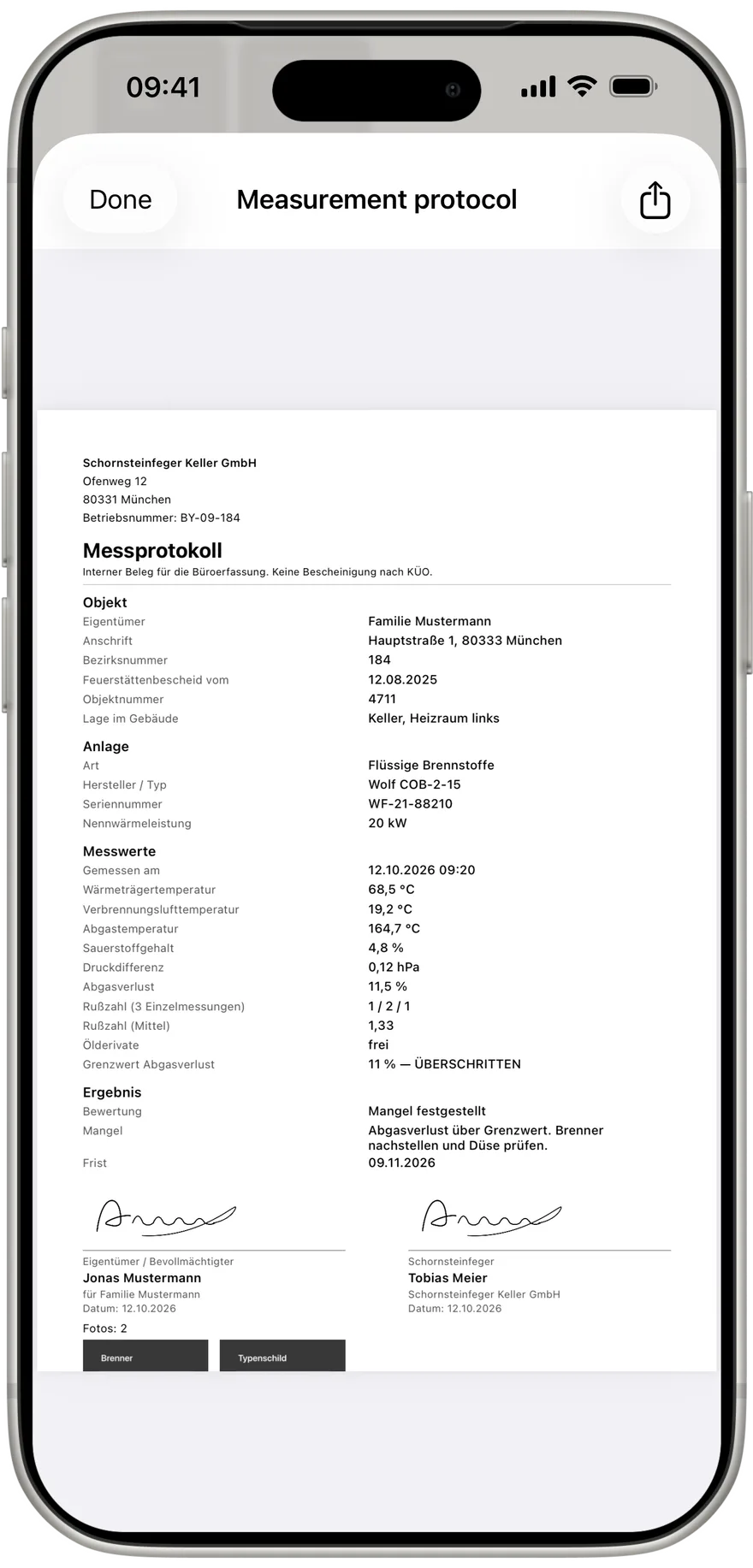
The PDF names the legal basis the check used under the measured values, and the reference oxygen where it applies. The note under the heading names the country's official document: the KÜO certificate in Germany, the inspection report under state law in Austria, the Feuerungsrapport under LRV in Switzerland. The day export CSV has the columns Bewertungsland, Rechtsgrundlage and Bezugssauerstoff_Prozent. An office with properties in two countries sees in every row which limit is meant.
Try it with your country's rule set
Choose the country, add an appliance, measure. No account, no signal needed, free for one person for good.
Where do I set the country?
Under Business, in the Country row. Individual properties also have their own Country row in the property details.
Does changing the country alter old measurements?
No. Completed measurements keep the country they were completed under. New properties take the new country.
Why does a Swiss appliance ask for burner and stage?
Because in Switzerland the flue gas loss limit comes from burner, stage and commissioning date, not from the output.
Is it the same in every Austrian state?
Limits and measured values come from the Art. 15a B-VG agreement and are the same nationwide. That is why the app has one Austrian rule set.
Is the protocol in German for Austria and Switzerland too?
Yes. The PDF is always in German and names the legal basis of the country in question.
Try Kehrwerk on your next reading.
The chimney sweep app for flue gas readings on site. Free forever for one person, no signup.