Measuring solid fuel appliances: wood stoves, log boilers, pellet boilers
Dust, carbon monoxide, wood moisture and 13 percent reference oxygen. What the 1. BImSchV requires for solid fuel installations, when a wood stove is measured and which values belong in the protocol under Annex 2 No. 5.
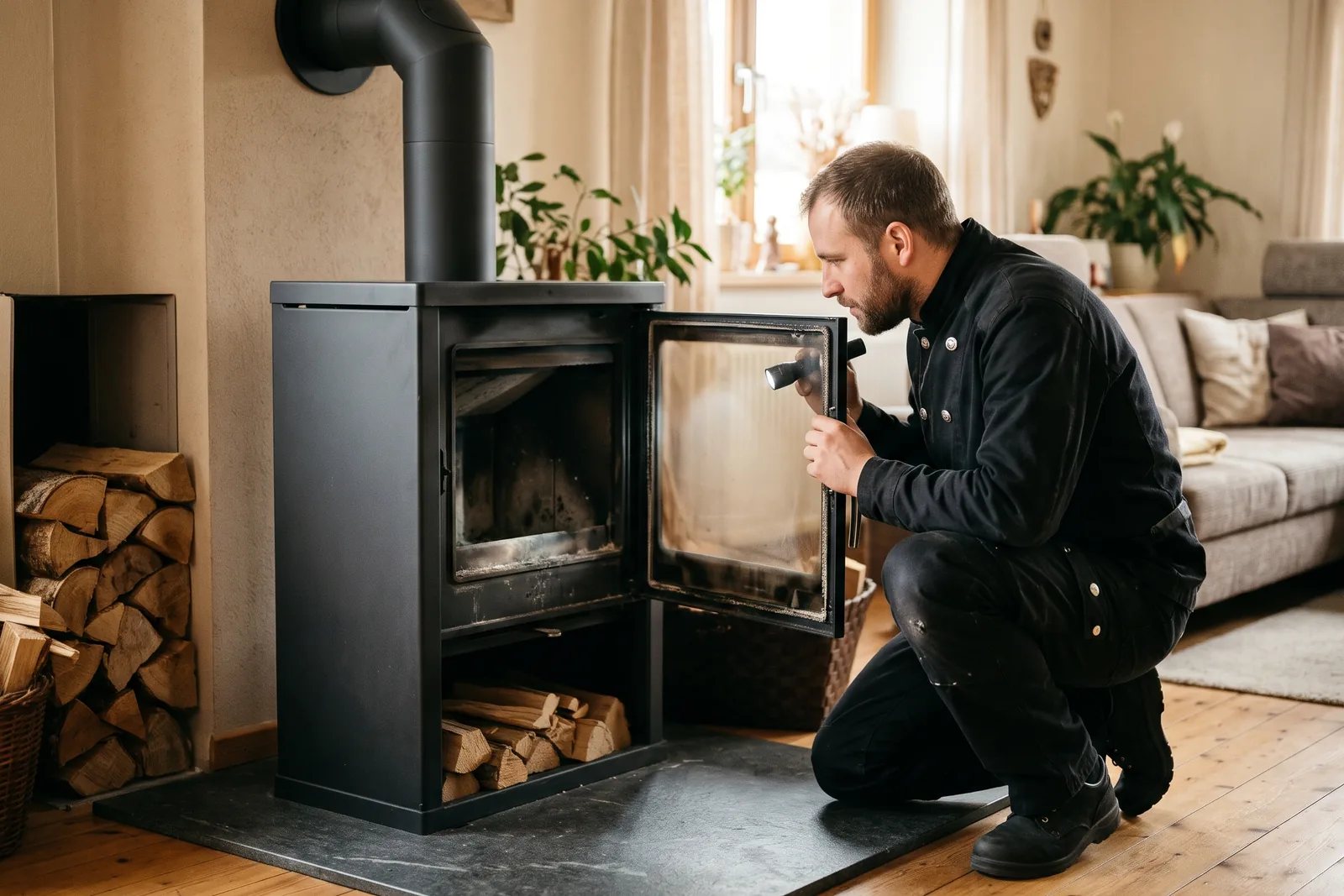
For a chimney sweep, measuring a solid fuel appliance is different work from the gas boiler. Dust and carbon monoxide take the place of flue gas loss, the measurement runs for a quarter of an hour, and with a wood stove the moisture meter often comes out too. This article sets out what the German 1. BImSchV requires for wood stoves, log boilers and pellet boilers, and shows how Kehrwerk records the measurement under Annex 2 No. 5.
Everything here is taken from the text of the 1. BImSchV. The only binding text is the ordinance in its current version.
The right fields for solid fuels
For wood and pellets, Kehrwerk shows exactly the values from Annex 2 No. 5. Free for one person.


Boiler or room heater
The ordinance separates two groups, and the split decides almost everything else. Under § 2 No. 3, a room heater is an installation used mainly to heat the room it stands in, plus cookers with or without an indirectly heated oven. The wood stove in the living room is one, so is the tiled stove. Everything else, meaning log, wood chip and pellet boilers, counts as an installation under § 5.
Kehrwerk mirrors exactly this split. When you add the appliance you choose solid fuel boiler or room heater, as on the forms of KÜO Annex 2.
Limits for boilers under § 5
§ 5 (1) limits the mass concentrations of dust and carbon monoxide for solid fuel installations from 4 kW, room heaters excepted. For stage 2 installations, built after 31 December 2014, burning fuels under § 3 (1) No. 1 to 5a, which include logs, wood chips and pellets, the limits are:
- Dust: 0.02 grams per cubic metre
- Carbon monoxide: 0.4 grams per cubic metre
For installations burning only logs, § 5 (1) sentence 2 applies the stage 2 values only to installations built after 31 December 2016. For older installations the table gives the stage 1 values, and § 25 governs the transition for existing ones. Under § 4 (2), the emission limits refer to an oxygen content in the flue gas of 13 percent.
When it is measured
Under § 15 (1), the operator of a solid fuel installation from 4 kW, room heaters excepted, has compliance confirmed by measurement once in every second calendar year. The fuel requirements are checked at the same time. New or substantially modified installations are measured within four weeks of commissioning under § 14 (2).
For the wood stove the rule is different. Under § 15 (2), the operator of a solid fuel room heater has the requirements of § 3 (3) and § 4 (1) checked during the regular fireplace inspection. Those are the moisture of the fuel, the proper technical condition and the use of permitted fuels.
Wood moisture below 25 percent
§ 3 (3) allows fuels under § 3 (1) No. 4 to 8 and 13 only if their moisture content is below 25 percent relative to dry weight. Automatically fed installations that the manufacturer rates for wetter fuels are exempt. Annex 2 No. 1 requires moisture to be measured with instruments that measure electrical conductivity, with equivalent methods allowed.
In Kehrwerk, moisture content has its own field on every solid fuel appliance. The value appears in the protocol and in the CSV.
Wood moisture, dust and CO in one protocol
Measure, photograph the wood store, get it signed. Download Kehrwerk and start without an account.
How the boiler measurement runs
Annex 2 No. 2 sets the procedure for solid fuels:
- Measurements are taken at a boiler temperature of at least 60 degrees Celsius.
- For hand-fed installations, measuring starts five minutes after the largest fuel load named in the operating manual has been placed on a sufficient bed of embers.
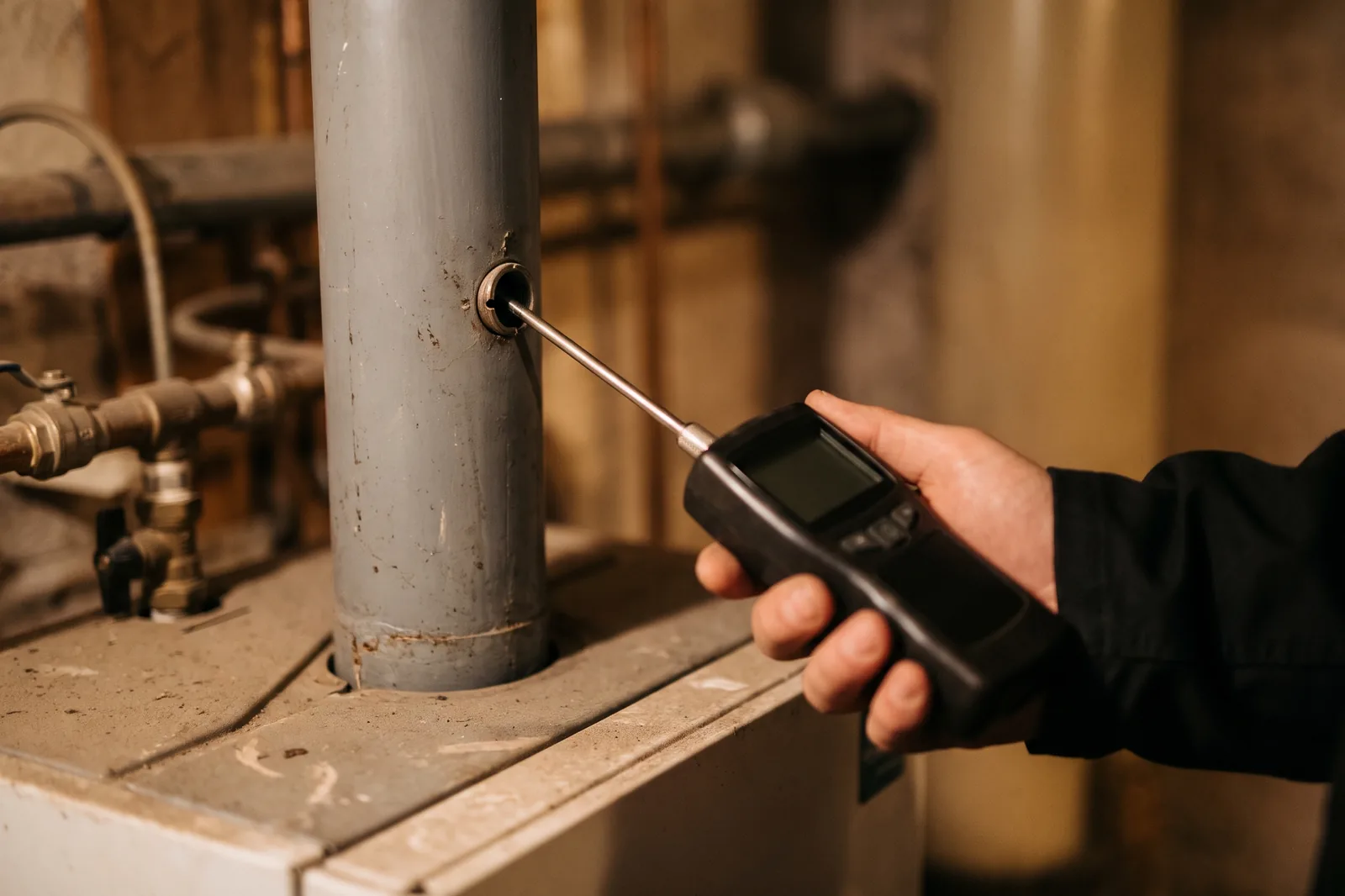
- Emissions are determined together with oxygen as a quarter hour average, with a type-tested measuring device.
- Measured emissions are converted to reference oxygen: E B = (21 minus reference O2) divided by (21 minus measured O2) times E M.
- The result is determined with one more decimal than the limit. The limit is met if the reading minus the measurement uncertainty does not exceed it.
Annex 2 No. 1.4 also requires draught and flue gas temperature to be measured to judge the operating state, and the heat carrier temperature shown by the operating instruments to be recorded.
What goes in the protocol: Annex 2 No. 5
Under Annex 2 No. 5, the certificate for solid fuel installations contains, among other things, the appliance with manufacturer, type, year of installation, rated output, design and feed type, the fuel used, heat carrier temperature, flue gas temperature, oxygen and draught, dust and carbon monoxide each with its measurement uncertainty, the applicable limits and the moisture content measured for the fuel.
These are exactly the readings Kehrwerk asks for on a solid fuel appliance in Germany: heat carrier temperature, flue gas temperature, oxygen, draught, dust, carbon monoxide and moisture content. You enter dust and CO in milligrams per cubic metre, as most analysers show them. 0.02 grams per cubic metre is 20 mg/m³, 0.4 grams per cubic metre is 400 mg/m³.
Older wood stoves under § 26
§ 26 covers room heaters built before 22 March 2010. They may only stay in use if 0.15 grams of dust and 4 grams of carbon monoxide per cubic metre are not exceeded. Proof is a test bench certificate from the manufacturer or a measurement by the chimney sweep. Without proof, stoves had to be retrofitted or taken out of use by a date set by the rating plate. The last stage ran to 31 December 2024 for rating plates dated 1 January 1995 to 21 March 2010. Exempt are, among others, open fireplaces, masonry heaters and non-commercial cookers and ovens under 15 kW.
Austria and Switzerland
If you set Austria as the country in Kehrwerk, the app checks flue gas loss and CO on solid fuel installations under 50 kW against Art. 13 of the Art. 15a B-VG agreement. The values depend on how the appliance is fed, so the app asks whether it is hand-fed or automatic. For Switzerland, Kehrwerk asks for particulates and CO at 13 percent reference oxygen.
From the wood stove to the pellet boiler
One app for every appliance, offline and free forever for one person. Download it now.
Does a wood stove have to be measured regularly?
Room heaters are exempt from recurring measurement under § 15 (1). Under § 15 (2), fuel moisture, technical condition and fuels are checked during the fireplace inspection.
How damp may firewood be?
Below 25 percent relative to dry weight, under § 3 (3) of the 1. BImSchV. Automatically fed installations rated by the manufacturer for wetter fuels are exempt.
Which oxygen level do the limits refer to?
For solid fuels, 13 percent under § 4 (2). The conversion formula is in Annex 2 No. 2.2.
How long does a measurement on a wood boiler take?
Dust and CO are determined as a quarter hour average, together with oxygen, under Annex 2 No. 2.2.
Which values does Kehrwerk ask for on solid fuels?
Heat carrier temperature, flue gas temperature, oxygen, draught, dust, carbon monoxide and moisture content, as in Annex 2 No. 5 of the 1. BImSchV.
Try Kehrwerk on your next reading.
The chimney sweep app for flue gas readings on site. Free forever for one person, no signup.