Flue gas loss limits under the 1. BImSchV: the table by kW
11, 10 or 9 percent: which flue gas loss limit applies to oil and gas firing depends on the rated heat output. The table from § 10, the exceptions and what else is limited during the measurement.
Every chimney sweep in Germany knows it by heart: the table of flue gas loss limits under the 1. BImSchV. It still pays to look closely, because next to the three familiar numbers the ordinance sets out exceptions, a one point increase and rounding rules that are easy to lose in daily work. This article collects what § 10 of the Ordinance on Small and Medium Combustion Plants actually says, and shows how Kehrwerk checks the right limit as you type.
Everything here is taken from the text of the ordinance on gesetze-im-internet.de. The only binding text is the 1. BImSchV in its current version.
The app already knows the right limit
Enter the rated output once and Kehrwerk checks every flue gas loss automatically. Free for one person.


The table in § 10 (1)
§ 10 (1) sentence 1 of the 1. BImSchV states that for oil and gas firing installations, the flue gas losses determined by the method of Annex 2 No. 3.4 must not exceed the following percentages:
- Rated heat output from 4 to 25 kilowatts: 11 percent
- Rated heat output above 25 to 50 kilowatts: 10 percent
- Rated heat output above 50 kilowatts: 9 percent
What counts is the rated heat output of the appliance, not the output set during the measurement. The 25 kW boundary still belongs to the first band, the 50 kW boundary still to the second.
One point more for standard boilers
§ 10 (1) sentence 2 contains a special rule that is often missed. If a boiler that meets the efficiency requirements of Directive 92/42/EEC cannot meet the limit because of its design, a value one percentage point higher applies. The condition is that the boiler is declared a standard boiler under Article 2 of the directive in its declaration of conformity and carries the CE mark.
Kehrwerk checks against the value in the table. Whether the higher value applies to a particular standard boiler is your call from the documents on site, noted in the result of the measurement.
Where § 10 does not apply
The ordinance expressly excludes several installations. Under § 10 (3), the limit does not apply to:
- room heaters with a rated heat output of 11 kilowatts or less,
- installations of 28 kilowatts or less that serve only to heat domestic water.
Under § 10 (2), installations that cannot meet the limit because of their intended function must match the state of the art for their process or design. And § 14 (3) No. 4 exempts installations set up as condensing boilers from monitoring with regard to the requirements of § 10. Through § 15 (4), this exemption also covers recurring monitoring.
What else is limited for oil
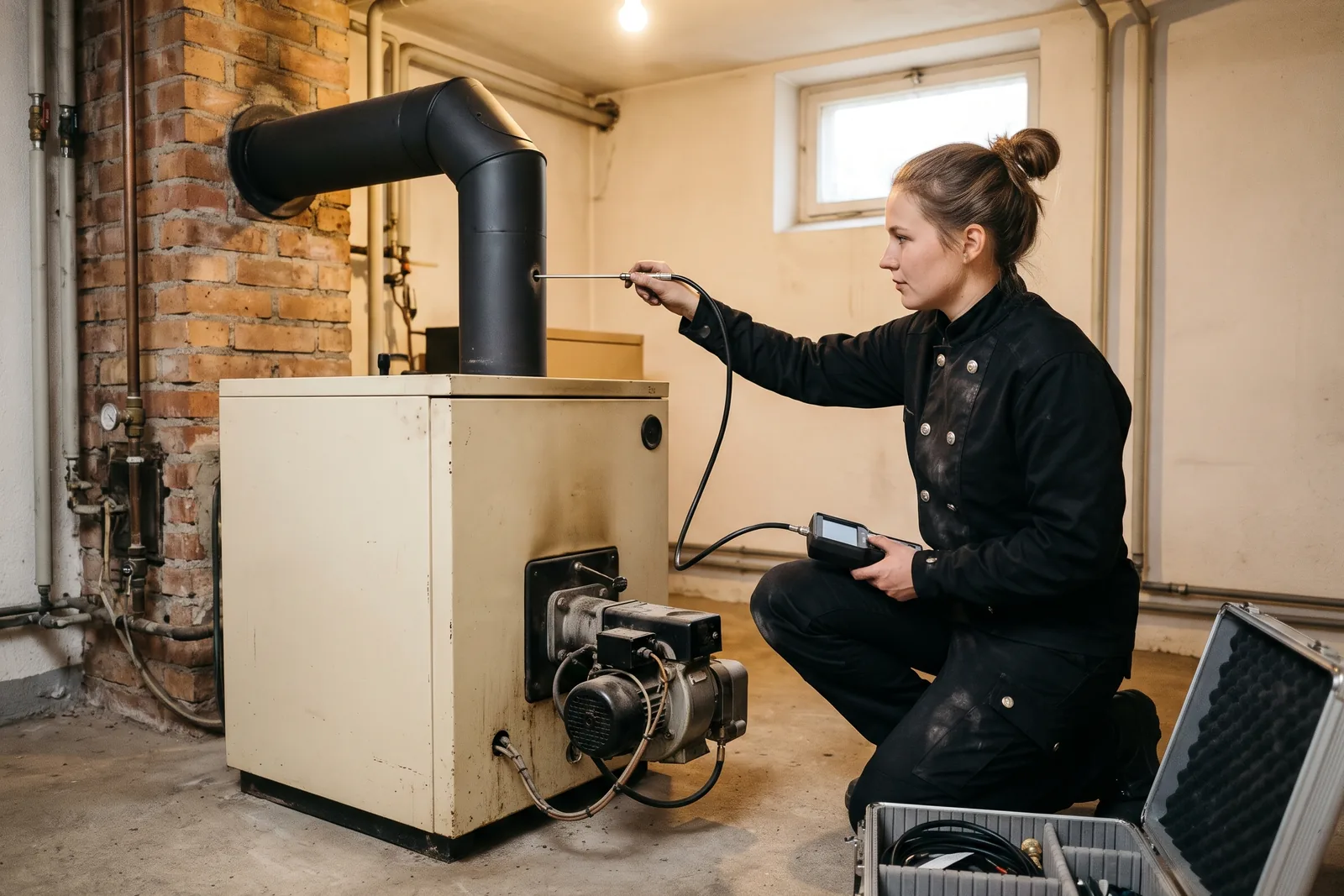
For oil firing, §§ 7 and 8 refer to the flue gas loss under § 10 and add further requirements. With atomising burners the smoke number must not exceed 1, with vaporising burners 2. The flue gas must be free of oil derivatives, and carbon monoxide must not exceed 1,300 milligrams per kilowatt hour. Both sections allow different smoke numbers for older installations, depending on when they were built.
How the smoke number and oil derivatives are determined is set out in Annex 2 No. 3.2 and 3.3: three single readings under DIN 51402 Part 1, arithmetic mean, rounded to the nearest whole number. Kehrwerk asks for the three values separately and calculates the mean itself.
Gas: § 9 points to the same table
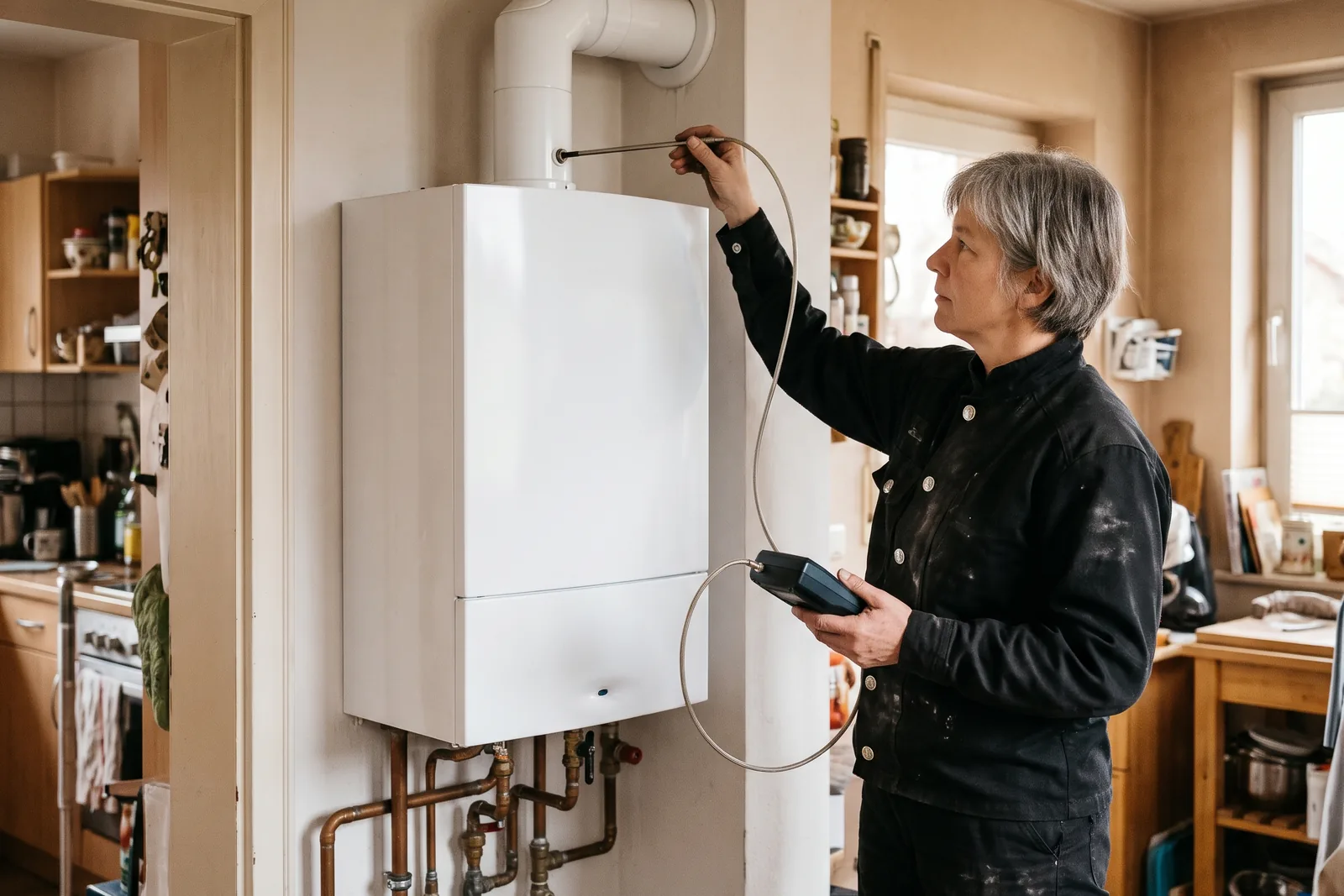
For gas firing, § 9 (2) simply says the flue gas loss limits of § 10 (1) must be met. The wall-mounted boiler in the kitchen therefore follows the same bands by rated output as the oil boiler in the cellar.
11, 10 or 9 percent without looking it up
Kehrwerk shows as you type whether the flue gas loss is within the limit. Download, add the appliance, measure.
Rounded with one extra decimal
Annex 2 No. 3.4.2 refers to No. 2.3 for the flue gas loss. The result is determined with one decimal place more than the limit value and rounded under DIN 1333. The limit is met if the measured value minus the measurement uncertainty does not exceed it. With a limit of 11 percent you therefore work to one decimal place.
Kehrwerk takes the value exactly as you type it, with comma and decimal, and compares it with the limit. What you enter appears unchanged in the PDF and the CSV.
How often it is measured
§ 15 (3) sets the frequency of recurring measurement for oil and gas installations from 4 kW: once in every third calendar year where commissioning or substantial modification was twelve years ago or less, once in every second calendar year for older installations. Installations with self-calibrating continuous combustion control are measured once in every fifth calendar year.
New or substantially modified installations must be measured within four weeks of commissioning under § 14 (2). If an inspection finds a defect, the operator must remedy it under § 14 (5) and have the measurement repeated.
How Kehrwerk checks the limit
In Kehrwerk you enter the rated heat output once on the appliance. The app maps it to the right band: above 4 to 25 kW 11 percent, above 25 to 50 kW 10 percent, above 50 kW 9 percent. On every measurement at that appliance, the flue gas loss field says whether the value is within the limit. If it is above, the field turns red and the protocol says exceeded next to the limit.
- The band comes from the appliance data, not from memory.
- The limit appears in the PDF together with its legal basis.
- You see a breach on site, while you can still adjust the burner.
For appliances close to a band boundary, such as a 26 kW boiler, that prevents the most common mistake: the wrong row of the table in your head.
Try it on the next gas boiler
Free forever for one person, no account. Your readings stay on your phone, even with no signal.
Which limit applies at exactly 25 kW?
11 percent. The table in § 10 (1) of the 1. BImSchV groups 4 up to and including 25 kW. Above 25 up to and including 50 kW, 10 percent applies.
Does the flue gas loss limit apply to condensing boilers?
Under § 14 (3) No. 4, installations set up as condensing boilers are exempt from monitoring with regard to the requirements of § 10. Through § 15 (4), that also covers recurring measurement.
When does one extra point apply?
For a boiler under Directive 92/42/EEC that is declared a standard boiler in its declaration of conformity, carries the CE mark and cannot meet the limit because of its design. That is § 10 (1) sentence 2.
Does Kehrwerk check Austria and Switzerland too?
Yes. Set the country for your business and the app checks under the Art. 15a B-VG agreement or the Swiss Ordinance on Air Pollution Control.
Where is the binding text?
The full 1. BImSchV is on gesetze-im-internet.de. The ordinance text is binding, not this summary.
Try Kehrwerk on your next reading.
The chimney sweep app for flue gas readings on site. Free forever for one person, no signup.