Measuring the smoke number on oil heating: three readings, the mean, oil derivatives
Three filter papers, one mean, one visual check for oil derivatives. What Annex 2 of the 1. BImSchV requires for the smoke number, which limits apply and how the values reach the protocol without a scrap of paper.
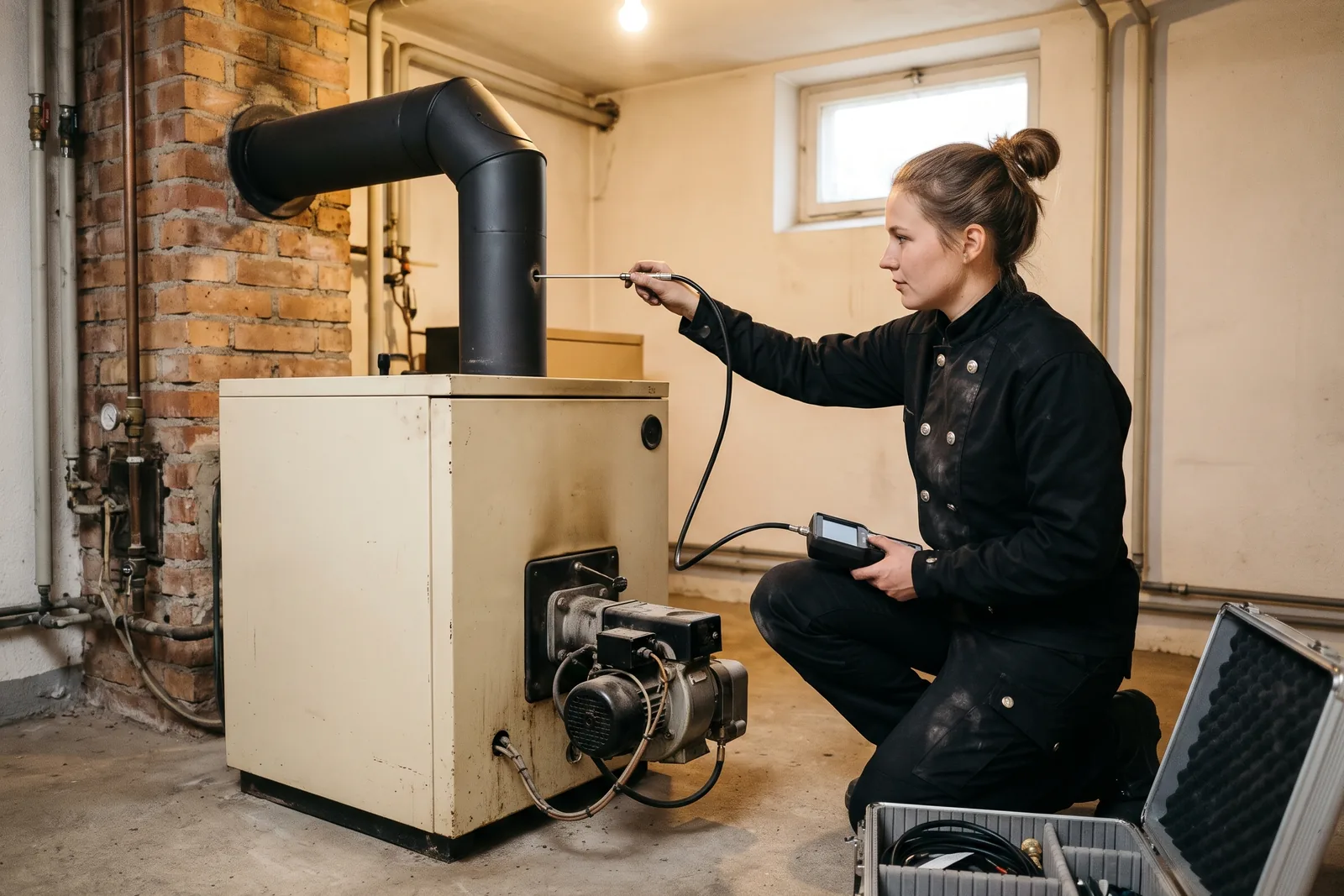
On every oil installation, the smoke number (Rußzahl) is part of the chimney sweep's flue gas measurement. The pump draws flue gas through the filter paper, the spot is compared with the reference scale, three times in a row. Then you take the mean and look at the three filters for oil derivatives. It is routine, but the rules behind it are more precise than many people remember. This article sums up what the 1. BImSchV says about the smoke number on oil heating and shows how Kehrwerk records the three values and works out the mean for you.
The basis is Annex 2 No. 3.2 and 3.3 and §§ 7 and 8 of the 1. BImSchV. The only binding text is the ordinance itself.
Type three smoke numbers, the app does the mean
No mental arithmetic on the filter paper. Kehrwerk is free forever for one person.


What the smoke number measures
The smoke number describes how dark a filter paper is stained by particles in the flue gas. The reference scale has ten steps from 0 to 9. The darker the spot, the higher the number, and the less completely the oil burns. A high smoke number almost always points to a wrong setting, a worn nozzle or too little combustion air.
The procedure in Annex 2 No. 3.2
The 1. BImSchV sets out the smoke number test in Annex 2 No. 3.2, briefly and clearly:
- The smoke number is determined visually under DIN 51402 Part 1, October 1986 edition.
- Three single readings are taken.
- A further reading is required if the filter paper became noticeably damp from condensate or is unevenly stained.
- The arithmetic mean of the single readings is calculated.
- The result, rounded to the nearest whole number, complies if it does not exceed the set smoke number.
So what decides is the rounded mean, not the worst single reading. Three readings of 1, 1 and 2 give a mean of 1.33, rounded 1.
Which smoke number is allowed
The limits are in §§ 7 and 8 of the 1. BImSchV and depend on the burner:
- Oil firing with atomising burners (§ 8): smoke number 1.
- Oil firing with vaporising burners (§ 7): smoke number 2.
Both sections allow exceptions for older installations. Under § 8, atomising burners built up to 1 October 1988, or up to 3 October 1990 in the territory named in Article 3 of the Unification Treaty, may not exceed smoke number 2, unless the installation has been substantially modified. Under § 7, vaporising burners of 11 kW or less built before 1 November 1996 are held to smoke number 3.
The oil derivatives check
Annex 2 No. 3.3 requires the check for oil derivatives on the same filter papers used for the smoke number. Each paper is first inspected with the naked eye. If it shows discolouration, that filter is discarded for the smoke number. If no clear decision is possible, a solvent test under DIN 51402 Part 2 follows after the smoke number has been determined.
The requirement is met if no oil derivatives are found on any of the three filter samples. §§ 7 and 8 require the flue gas to be free of oil derivatives for both burner types.
Smoke number and oil derivatives in one step
Three fields, one mean, one choice of free or found. Download Kehrwerk and try it on the next oil boiler.
What belongs in the protocol
Annex 2 No. 4 sets out the minimum content of the certificate for installations burning liquid fuels. For the smoke number, that means the values of all single readings and the mean. The result of the oil derivatives check comes on top. A protocol that only gives the mean is not enough.
How Kehrwerk records the smoke number
When you choose an appliance for liquid fuels in Kehrwerk, a separate smoke number section appears under the readings, with three fields: 1st, 2nd and 3rd reading. Below them is the mean, which the app calculates as soon as the first value is in. You do no mental arithmetic and write nothing on the filter paper.
- Each field accepts whole numbers from 0 to 9. A 12 or a 1.5 is flagged as invalid at once.
- The mean is shown to two decimal places, so you see the rounding yourself.
- In the oil derivatives section you choose free of oil derivatives or oil derivatives found.
- The PDF lists all three single readings, the mean and the result of the oil derivatives check.
If your business works in Austria or Switzerland, Kehrwerk also checks the mean against the limit set there. In Austria that is smoke number 1 for liquid fuel installations under 50 kW, under Art. 13 of the Art. 15a B-VG agreement. In Switzerland, the Ordinance on Air Pollution Control sets smoke number 1 for extra light heating oil in Annex 3 No. 411.
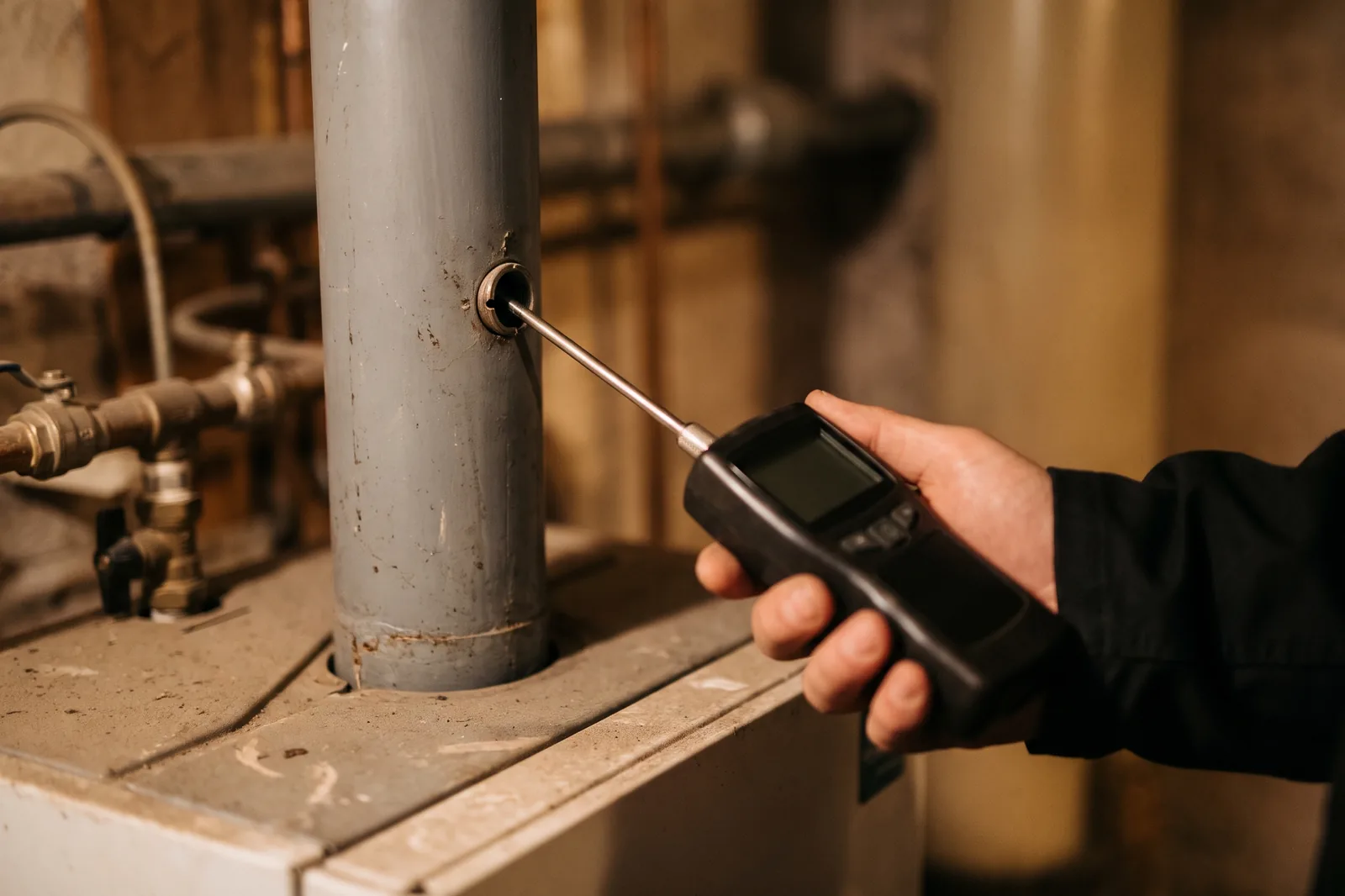
Saved while you type
With the smoke number in particular, a few minutes pass between readings in which the phone goes into a pocket or rings. Kehrwerk writes every entry at once. When you come back after the call, the first two values are still there, even if the app was closed in between. You do not need a signal for any of it.
No more smoke numbers on the back of your hand
Kehrwerk is free forever for one person, no account. For iPhone and Android.
How many single readings does the smoke number need?
Three, under Annex 2 No. 3.2 of the 1. BImSchV. Another is due if a filter paper is noticeably damp from condensate or unevenly stained.
Is the mean rounded?
Yes. The arithmetic mean, rounded to the nearest whole number, is compared with the set smoke number.
Which smoke number applies to an atomising burner?
For oil firing with atomising burners, § 8 sets smoke number 1, with an exception for older installations that have not been substantially modified. For vaporising burners, § 7 sets smoke number 2.
What happens to a filter that shows oil derivatives?
It is discarded for the smoke number. If the visual check is not clear, a solvent test under DIN 51402 Part 2 follows.
Does Kehrwerk work out the mean automatically?
Yes. As soon as one value is entered, the mean appears under the three fields, and the protocol shows every single reading and the mean.
Try Kehrwerk on your next reading.
The chimney sweep app for flue gas readings on site. Free forever for one person, no signup.